
Imagine a future where your eyes become an intelligent interface—an always-on bridge between the physical world and digital intelligence.
The concept of NeuroVision X Goggles represents that future, where vision is enhanced, contextual, and deeply interactive. This is not a product announcement,
but a believable look at how wearable vision technology could evolve in the coming decade.
Expected Future Price
Estimated Future Price (Conceptual):
- USD: $2,499
- INR: ₹2,05,000 (approx.)
- GBP: £1,999 (approx.)
This is a future-based estimated price derived from projected component evolution, adoption curves, and next-generation interface technologies.
Design & Futuristic Concept
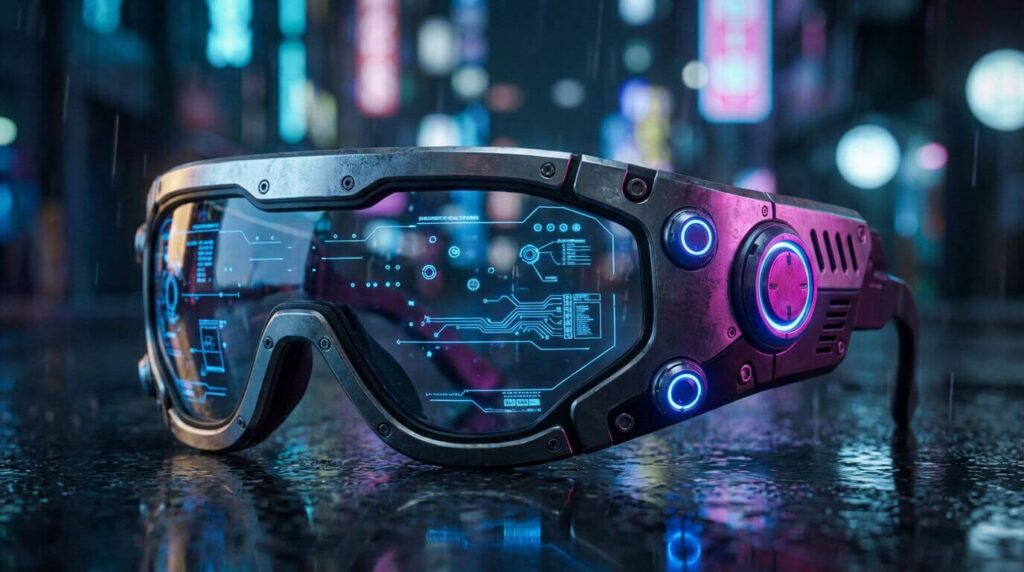
The NeuroVision X Goggles concept abandons the fragile, consumer-toy look of today’s smart glasses. Instead, it embraces an industrial yet refined design—protective, modular, and purpose-built for continuous daily use.
The goggle-style frame suggests a future where wearable vision devices are no longer fashion accessories, but essential tools.
The curved transparent visor integrates a seamless digital overlay, eliminating the “screen” feeling entirely. Rather than displaying floating panels,
information appears embedded into the environment itself—depth-aware, spatially anchored, and responsive to eye movement.
The outer housing hints at adaptive materials that adjust opacity, temperature, and structural rigidity based on environment and usage intensity.
NeuroVision X Goggles This is vision hardware designed for a mixed-reality world, not a smartphone replacement strapped to the face.
Key Features & Capabilities (Conceptual)
Context-Aware Visual Intelligence
NeuroVision X is imagined as a system that understands surroundings in real time. Streets, rooms, machinery, or natural landscapes are interpreted instantly,
with relevant information surfaced only when needed. Unlike today’s notification-driven tech, the experience is calm, minimal, and intent-based.
Eye-Driven Interface Control
Touch, swipe, and tap are replaced by subtle eye gestures and focus-based selection. The goggles respond to how long you look,
how your gaze shifts, and what you ignore. This creates a frictionless interface that feels more like thought than control.
Adaptive Reality Layers
Instead of a single augmented view, users can switch between “reality layers”—navigation mode, work mode, learning mode, or creative mode.
Each layer reshapes how the world is presented without fully disconnecting the user from their physical surroundings.
Private, Localized Processing
A major future shift is privacy-first design. NeuroVision X Goggles is conceptually built around localized intelligence, minimizing constant cloud dependency.
Sensitive visual data stays personal, processed within the device ecosystem rather than streamed externally.
Comparison With Today’s Technology
Today’s AR and VR devices still feel experimental. They rely heavily on bulky headsets, limited battery life, and visually intrusive interfaces. Most importantly, they demand the user adapt to the technology.
NeuroVision X Goggles flips that relationship. Instead of users learning menus and controls, the system learns the user—habits, environments, priorities. Current smartphones act as attention magnets; this future device acts as an attention filter.
Where today’s wearables add more screens to our lives, future vision systems aim to remove screens altogether.
Future Use Cases & Lifestyle Impact
Professional Workflows
Engineers, surgeons, architects, and field technicians could operate with persistent visual assistance—real-time spatial guidance, risk alerts, and layered instructions without looking away from their work.
Urban Navigation & Travel
In future cities, navigation becomes intuitive. Directions appear as subtle environmental cues rather than loud arrows. Language barriers dissolve as visual translation overlays signage and conversations naturally.
Learning & Skill Development
Education shifts from passive content to experiential learning. Historical events, scientific concepts, or mechanical systems can be visually explored in real-world contexts, accelerating understanding and retention.
Digital Well-Being
Ironically, advanced vision tech may reduce digital overload. By integrating information directly into context, users spend less time switching devices and more time engaged with the real world.
Industry & Market Impact
The emergence of devices like NeuroVision X Goggles would signal a major transition—from the smartphone era to the vision-interface era. Entire industries would adapt, including software design, advertising, education, and workplace collaboration.
App ecosystems would evolve into “visual services.” Websites would become spatial experiences. Traditional screens would no longer be the primary gateway to the digital world.
For markets like the USA, India, and the UK, adoption would follow different paths—enterprise first, then professionals, and eventually everyday consumers as costs decrease and cultural comfort grows.
Conclusion
NeuroVision X Goggles represent more than futuristic eyewear—they symbolize a fundamental shift in how humans interact with technology.
A future where information respects attention, enhances reality, and adapts to human behavior rather than competing for it.
At an estimated $2,499, such technology would initially belong to professionals and early adopters. But like smartphones before it,
vision-based computing may eventually become invisible, essential, and impossible to imagine living without.
The future of technology may not be in our hands—but right before our eyes.
Optional CTA
Explore more future-focused technology concepts and deep industry insights to stay ahead of what’s coming next.