
Are Cat Years the Same as Dog Years? The Complete Guide to Pet Age in Human Years

You’ve heard it a thousand times — “one human year equals seven dog years.” It rolls off the tongue easily, it sounds logical, and almost everyone believes it.
There’s just one problem: it’s not true.
And when it comes to cats? Most people don’t even have a formula — they just assume it works the same way as dogs. That assumption is also only partially right.
So, are cat years the same as dog years? The short answer is: not exactly — but the two are more similar than you might think, especially in the early years of life. Where things get interesting is how they diverge as your pet gets older — and why that difference actually matters for how you care for them.
In this guide, you’ll find:
- The real science behind how cats and dogs age
- Easy-to-read comparison charts for both
- A direct side-by-side comparison of cat years vs dog years
- Practical care tips based on your pet’s true life stage
- Answers to the most common pet age questions
Whether you have a curious kitten, a middle-aged mutt, or a senior cat who’s been around longer than your last smartphone — this guide will help you understand exactly where your pet stands in their life journey.
The “7 Dog Years” Myth — Where Did It Come From?

If you trace the “one year equals seven dog years” rule back to its roots, you won’t find a veterinarian or a scientist behind it. The most likely explanation is that it was a simple math trick — humans live to roughly 70, dogs live to roughly 10, so someone divided 70 by 10 and called it a day.
Catchy? Yes. Accurate? Not even close.
Here’s why the rule falls apart almost immediately. A one-year-old dog is not the equivalent of a 7-year-old child. By their first birthday, most dogs are fully sexually mature, physically developed, and navigating the world with the confidence of a teenager — not a second-grader. Using the 7-year rule, a 2-year-old dog would be “14 in human years.” In reality, that same dog is behaviourally and physically closer to a 24-year-old adult.
The rule also completely ignores one of the most important variables in dog aging: size and breed. A Great Dane and a Chihuahua do not age at the same rate. Large breeds age significantly faster than small ones — something a single, flat multiplier could never account for.
Modern veterinary science has moved well beyond the 7-year myth. Today, organizations like the American Veterinary Medical Association (AVMA) and International Cat Care (ICC) use life-stage models that reflect how pets actually age — quickly at first, then gradually slowing down.
The 7-year rule had a good run. It’s time to retire it.
How Do Dogs Age in Human Years?
Dogs age at a surprisingly rapid pace in their first two years of life. After that, things slow down considerably — though how quickly they continue to age depends a lot on their size.
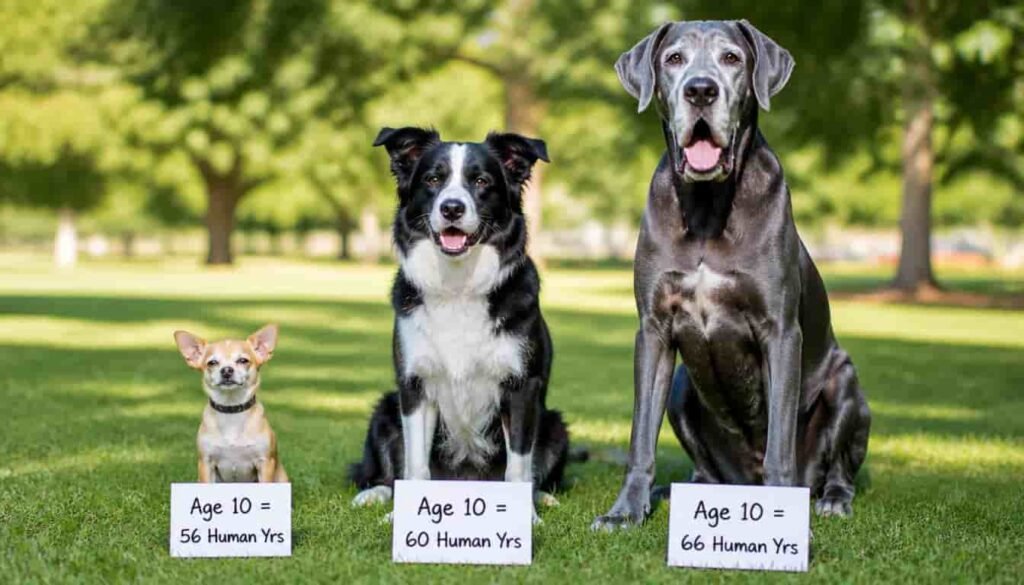
Here’s how it generally breaks down:
- Year 1: A dog reaches the equivalent of about 15 human years. In just 12 months, they go from a helpless newborn to a fully grown, sexually mature young adult.
- Year 2: Add another 9 human years. By their second birthday, your dog is the equivalent of a 24-year-old human.
- Year 3 onwards: The aging process slows. Each additional dog year equals roughly 4–5 human years, depending on breed and size.
Does Size Matter? Absolutely.
This is where dog aging gets more nuanced than cat aging. Larger dogs age faster than smaller ones — and the difference becomes significant after age 5 or 6. A 10-year-old Chihuahua is roughly equivalent to a 56-year-old human. A 10-year-old Great Dane? Closer to 78. Same number of candles on the cake, very different biological reality.
🐶 Dog Age to Human Years Chart
| Dog’s Age | Small (≤20 lbs) | Medium (21–50 lbs) | Large (50+ lbs) |
|---|---|---|---|
| 1 | 15 | 15 | 15 |
| 2 | 24 | 24 | 24 |
| 3 | 28 | 28 | 28 |
| 4 | 32 | 32 | 32 |
| 5 | 36 | 36 | 36 |
| 6 | 40 | 42 | 45 |
| 7 | 44 | 47 | 50 |
| 8 | 48 | 51 | 55 |
| 9 | 52 | 56 | 61 |
| 10 | 56 | 60 | 66 |
| 11 | 60 | 65 | 72 |
| 12 | 64 | 69 | 77 |
| 13 | 68 | 74 | 82 |
| 14 | 72 | 78 | 88 |
| 15 | 76 | 83 | 93 |
| 16 | 80 | 87 | 120 |
Based on AVMA guidelines
One thing worth noting — these numbers are averages. A well-fed, regularly exercised small breed dog with great genetics can age more gracefully than the chart suggests. Think of the chart as a helpful guide, not a verdict.
Alsoo read👉Can Dogs Eat Cat Treats? What Every Pet Owner Should Know
How Do Cats Age in Human Years?
If you swap “dog” for “cat” in the first two years, the aging formula looks almost identical. Cats also rocket through their early development, reaching the human equivalent of a teenager by their first birthday and a young adult by their second.
Here’s the general breakdown:
- Year 1: A cat reaches the equivalent of about 15 human years. In that first year alone, they go from a newborn to a fully mature, reproductively capable young adult.
- Year 2: Add another 9 years. By age two, your cat is the human equivalent of a 24-year-old.
- Year 3 onwards: Aging slows to roughly 4 human years per cat year — slightly more consistent than dogs.
One thing that makes cats simpler to calculate than dogs? Size plays a much smaller role. Unlike dogs, where a Great Dane and a Yorkshire Terrier age at completely different rates, most domestic cats follow a fairly similar aging trajectory regardless of how big or small they are.
🐱 Cat Age to Human Years Chart
| Cat’s Age | Human Years | Life Stage |
|---|---|---|
| 1 month | 1 year | Kitten |
| 3 months | 4 years | Kitten |
| 6 months | 10 years | Kitten |
| 1 year | 15 years | Junior |
| 2 years | 24 years | Young Adult |
| 3 years | 28 years | Young Adult |
| 4 years | 32 years | Mature Adult |
| 5 years | 36 years | Mature Adult |
| 6 years | 40 years | Mature Adult |
| 7 years | 44 years | Senior |
| 8 years | 48 years | Senior |
| 9 years | 52 years | Senior |
| 10 years | 56 years | Senior |
| 11 years | 60 years | Geriatric |
| 12 years | 64 years | Geriatric |
| 13 years | 68 years | Geriatric |
| 14 years | 72 years | Geriatric |
| 15 years | 76 years | Geriatric |
| 16 years | 80 years | Geriatric |
| 17 years | 84 years | Geriatric |
| 18 years | 88 years | Geriatric |
| 19 years | 92 years | Geriatric |
| 20 years | 96 years | Geriatric |
Based on International Cat Care (ICC) guidelines
Does Cat Breed Affect Aging?
To a lesser degree than dogs — but yes, it does matter. Some breeds are simply built to last longer than others.
- Maine Coons tend to live 12–15 years but are prone to heart conditions that can shorten their lifespan.
- Siamese cats are known for their longevity, often living well into their late teens.
- Ragdolls have an average lifespan of 12–17 years and tend to age gracefully.
- Mixed-breed (moggy) cats often outlive purebreds thanks to greater genetic diversity — a phenomenon known as hybrid vigour.
That said, lifestyle factors — diet, indoor vs outdoor living, veterinary care — tend to have a bigger impact on how a cat ages than breed alone.
Are Cat Years the Same as Dog Years? A Direct Comparison
Here’s the section you actually came for.
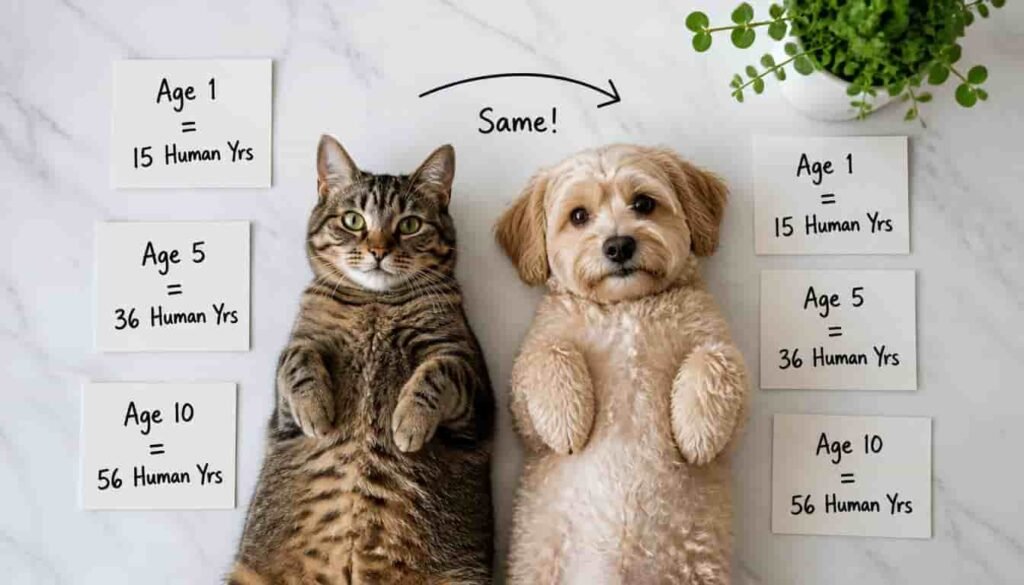
When you place cat and dog aging side by side, the first thing that stands out is how remarkably similar they are in the early years. Both species hit the human equivalent of 15 by their first birthday. Both reach 24 by year two. If you only looked at the first couple of years, you’d think the formulas were identical.
But from year three onwards, the picture starts to change — particularly when dog size enters the equation.
A 10-year-old cat and a 10-year-old small dog are roughly the same in human years — both around 56. But that same 10-year-old dog, if they’re a large breed, is already the equivalent of a 66-year-old human. Meanwhile, the cat is still cruising through what amounts to middle age.
This is the core difference: cats age more uniformly and often more slowly in their later years than medium and large dogs. It’s one of the reasons cats tend to outlive dogs on average — and why a 15-year-old cat isn’t unusual, while a 15-year-old Labrador is exceptionally rare.
🐱🐶 Cat Years vs Dog Years vs Human Years — The Ultimate Comparison Table
| Age (Pet Years) | Cat (Human Years) | Small Dog (Human Years) | Medium Dog (Human Years) | Large Dog (Human Years) |
|---|---|---|---|---|
| 1 | 15 | 15 | 15 | 15 |
| 2 | 24 | 24 | 24 | 24 |
| 3 | 28 | 28 | 28 | 28 |
| 4 | 32 | 32 | 32 | 32 |
| 5 | 36 | 36 | 36 | 36 |
| 6 | 40 | 40 | 42 | 45 |
| 7 | 44 | 44 | 47 | 50 |
| 8 | 48 | 48 | 51 | 55 |
| 9 | 52 | 52 | 56 | 61 |
| 10 | 56 | 56 | 60 | 66 |
| 11 | 60 | 60 | 65 | 72 |
| 12 | 64 | 64 | 69 | 77 |
| 13 | 68 | 68 | 74 | 82 |
| 14 | 72 | 72 | 78 | 88 |
| 15 | 76 | 76 | 83 | 93 |
The Key Takeaways From This Table
Where cats and dogs are the same:
- Years 1–5 are nearly identical across cats and small dogs
- The early aging formula (15 at year one, 24 at year two) applies to both species
Where they differ:
- From year 6 onwards, medium and large dogs age noticeably faster than cats
- A 12-year-old cat and a 12-year-old large dog are both “seniors” — but the dog is the equivalent of a 77-year-old while the cat is closer to 64
- Small dogs remain the closest in aging pace to cats throughout their lives
The bottom line: Cat years and dog years are not the same — but they’re not wildly different either. Think of them as two similar clocks that start at the same speed, then gradually tick at different rates depending on the dog’s size. Cats, for the most part, keep ticking steadily well into old age.
Why Do Cats and Dogs Age Differently From Humans?
It’s a fair question. Why do cats and dogs pack what amounts to 15 human years into their first year of life — and then slow down? And why do they age faster than us at all?
The answer comes down to a few interconnected biological factors.
Metabolic Rate and Body Size
As a general rule in biology, smaller animals have faster metabolisms and shorter lifespans. Their hearts beat faster, they breathe faster, and their cells divide more rapidly. This accelerated biological clock means they move through life stages — growth, sexual maturity, aging, decline — at a much faster pace than larger, slower-metabolising animals like humans.
Interestingly, this rule usually holds within species too, which is why large dog breeds age faster than small ones. A Great Dane’s body works harder and wears out sooner than a Chihuahua’s.
Reproductive Maturity Happens Fast
Both cats and dogs reach sexual maturity within their first year — cats as early as 4–6 months, dogs between 6–12 months depending on breed. Humans, by comparison, take 12–14 years to reach the same milestone. This early reproductive maturity is one of the biggest reasons that first year of a pet’s life maps to roughly 15 human years. A tremendous amount of biological development is crammed into a very short window.
The Epigenetic Clock — The Science of “True Age”
Here’s where it gets genuinely fascinating. In recent years, scientists have developed a way to measure biological age at the DNA level — known as the epigenetic clock.
Here’s the simple version: over time, tiny chemical markers called methyl groups attach themselves to specific points on DNA. The pattern of these markers changes predictably as an organism ages — in humans, dogs, cats, and many other species. By analysing these patterns, scientists can estimate how biologically “old” an animal actually is, independent of how many birthdays they’ve had.
A 2019 study from the University of California San Diego used this method to map dog aging onto human aging — and found that the relationship is not linear at all. Dogs age extremely rapidly early in life, then the pace slows. The epigenetic data actually aligned quite closely with the AVMA’s life-stage model — validating what vets had observed clinically for years.
The takeaway? Biological age and calendar age are not the same thing — for pets or for people. The charts in this article reflect our best understanding of that biological reality.
Why Do Cats Often Outlive Dogs?
Given that cats and dogs are similar in size and both kept as domestic pets, it’s worth asking: why do cats tend to live longer?
A few reasons are at play:
- Cats are obligate carnivores with a relatively simple, protein-focused metabolism that appears to support longevity
- Domestic cats, particularly indoor ones, face fewer physical risks than dogs — less intense exercise, fewer injuries
- Cats may have lower chronic stress levels than dogs in domestic settings, which is linked to slower cellular aging
- Genetically, cats show less variation in body size than dogs, which means fewer of the size-related aging penalties that affect large breeds
None of this makes one pet “better” than the other — it’s simply biology doing what biology does.
What Does Your Pet’s Age Actually Mean for Their Care?
Knowing your pet’s age in human years isn’t just a fun party trick. It’s genuinely useful information — because the care your pet needs changes significantly as they move through their life stages.
Think of it this way: you wouldn’t give a 70-year-old human the same diet, exercise routine, and medical check-up schedule as a 25-year-old. The same logic applies to your pet.
🐱 Life Stage Care Guide for Cats
Kitten (0–1 year / up to 15 human years) This is the most critical window for development. Kittens need calorie-dense food formulated for growth, a full vaccination schedule, and early socialisation. Spaying or neutering is typically recommended around 4–6 months.
Junior / Young Adult (1–6 years / 15–40 human years) Your cat is in their prime. They’re energetic, curious, and generally healthy. Annual vet check-ups are sufficient at this stage. Focus on maintaining a balanced diet, keeping them mentally stimulated, and monitoring their weight — indoor cats especially can become sedentary.
Mature Adult (7–10 years / 44–56 human years) This is the equivalent of your cat entering middle age. You may not notice dramatic changes, but this is the time to start paying closer attention. Bi-annual vet visits become worthwhile. Keep an eye on kidney function, dental health, and weight changes — all common concerns at this stage.
Senior (11–14 years / 60–72 human years) Senior cats need more frequent vet visits — at least twice a year. Bloodwork to check organ function becomes important. Diet may need adjusting for lower calorie needs and joint support. Watch for signs of hyperthyroidism, kidney disease, and arthritis, which are all common in older cats.
Geriatric (15+ years / 76+ human years) A geriatric cat deserves extra gentleness and attention. Prioritise comfort, warmth, and low-stress environments. Vet visits every 3–4 months are advisable. Pain management for arthritis, dental care, and appetite monitoring become central to their quality of life.
🐶 Life Stage Care Guide for Dogs
Puppy (0–1 year / up to 15 human years) Like kittens, puppies have enormous nutritional needs during this phase. Large breed puppies need specially formulated food to support controlled bone growth — too much calcium too fast can cause joint problems. Vaccinations, parasite control, and early training are all essential.
Adult (1–7 years / 15–50 human years) The adult stage varies significantly by size. Small breeds stay in this phase longer; large breeds enter their senior years earlier. Annual vet visits, regular dental care, consistent exercise, and a breed-appropriate diet are the pillars of good care here.
Senior (7–10 years / varies by size) For large breeds, senior care can begin as early as age 6–7. For small breeds, you might not notice senior changes until age 9–10. This is the stage to introduce joint supplements if needed, switch to senior-formulated food, and increase vet visit frequency to twice a year. Cognitive changes — like disorientation or disrupted sleep — can also begin here.
Geriatric (10+ years / varies by size) Geriatric dogs need a quieter, more comfortable routine. Exercise should be gentle and consistent rather than intense. Pain management, incontinence, vision and hearing loss, and cognitive decline are all real possibilities that deserve compassionate, proactive attention from both owners and vets.
The Universal Rule Across Both Species
Regardless of whether you have a cat or a dog, one principle applies across the board: the older your pet, the more frequently they should see a vet. What seems like a minor change in behaviour or appetite can be an early sign of something significant — and catching it early makes all the difference.
Signs Your Pet Is Aging

Charts and calculators are helpful, but your pet can’t tell you their birthday. Sometimes the clearest indicator of age isn’t a number — it’s what you observe day to day. Here are the signs to watch for in both cats and dogs as they move into their senior and geriatric years.
Physical Signs in Cats
Coat and skin changes A younger cat’s coat is typically smooth, glossy, and well-maintained. As cats age, the coat can become duller, coarser, or patchy. Older cats also groom less efficiently, so you may notice more matting — especially along the back and hindquarters, areas that are harder for them to reach.
Weight changes Both weight loss and weight gain can signal aging-related issues. Hyperthyroidism — extremely common in senior cats — often causes noticeable weight loss despite a healthy appetite. Kidney disease, another top concern in older cats, can also cause rapid weight loss.
Eyes A slight haziness or cloudiness in an older cat’s eyes can be normal. However, sudden vision changes, discharge, or visible discomfort should always be checked by a vet.
Mobility and movement Watch for hesitation when jumping, reluctance to use stairs, or stiffness after rest. Cats are masters at hiding pain — so if you notice even subtle movement changes, take them seriously.
Physical Signs in Dogs
Greying muzzle The most iconic sign of an aging dog. Grey or white fur around the muzzle and eyes typically begins appearing in medium and large breeds around age 5–7, and in small breeds a little later.
Joint stiffness and slowing down An older dog may take longer to get up after lying down, show reluctance to climb stairs, or lose enthusiasm for activities they used to love. This is often arthritis — one of the most common conditions in senior dogs.
Weight and muscle changes Senior dogs often lose muscle mass — particularly along the spine and hindquarters — even when their weight stays the same. This muscle wasting, known as sarcopenia, is a normal part of aging but can be slowed with appropriate exercise and diet.
Hearing and vision loss Cloudy eyes (nuclear sclerosis) are common in older dogs and don’t always impair vision significantly. True hearing loss is also common — if your dog stops responding to commands they’ve known for years, their hearing may be the issue, not their obedience.
Behavioural Changes to Watch in Both
- Increased sleep — normal to a point, but excessive lethargy warrants a vet visit
- Disorientation or confusion — a potential sign of Cognitive Dysfunction Syndrome (CDS), the pet equivalent of dementia
- Changes in appetite or thirst — especially increased thirst, which can signal kidney issues or diabetes
- Increased vocalisation — older cats especially may meow more, often due to discomfort, confusion, or sensory loss
- Withdrawal or reduced social interaction — a pet that suddenly becomes reclusive may be in pain or discomfort
When to Increase Vet Visits
As a general guide:
- Under 7 years — annual check-ups are typically sufficient
- 7–10 years — move to bi-annual visits
- 10+ years — every 3–4 months, or whenever you notice a change
The earlier a health issue is caught, the more treatment options are available — and the better the outcome tends to be. Trust your instincts as a pet owner. You know your animal. If something feels off, it probably is.
How to Estimate Your Pet’s Age If You Don’t Know It
If you adopted a rescue pet or took in a stray, there’s a good chance nobody handed you a birth certificate. The good news is that vets have several reliable methods for estimating a pet’s age — and you can pick up some useful clues yourself before you even get to the clinic.
Teeth: The Most Reliable Indicator
For both cats and dogs, the teeth are the single best age indicator — particularly in younger animals. Here’s a general guide:
Cats and Dogs (similar milestones):
| Age | What to Look For |
|---|---|
| 2–4 weeks | Baby (deciduous) teeth begin emerging |
| 8 weeks | All baby teeth are in |
| 3–4 months | Adult teeth start replacing baby teeth |
| 6–7 months | Full set of permanent adult teeth |
| 1–2 years | Teeth are white with minimal wear |
| 3–5 years | Some tartar buildup, mild wear visible |
| 5–10 years | More significant tartar, noticeable wear, possible gum recession |
| 10+ years | Heavy tartar, worn or missing teeth, potential tooth loss |
Teeth are most accurate for estimating age in animals under 2 years. After that, dental wear varies too much based on diet, dental care history, and individual genetics to be precise — but it still gives a useful ballpark.
Coat and Eyes
Coat: A young adult animal typically has a soft, even coat. As pets age, the fur may become coarser, thinner in patches, or greyer — especially around the face. Grey muzzle fur in a dog or a dull, unkempt coat in a cat both suggest middle age or beyond.
Eyes: Young pets have bright, clear eyes. With age, a subtle greyish-blue haze may develop in the lens — a condition called nuclear sclerosis. It typically appears in dogs around age 6–8 and in cats somewhat later. It’s different from cataracts and doesn’t usually impair vision significantly, but it’s a visible age marker.
Muscle Tone and Body Condition
Young, healthy pets tend to have good muscle definition and a lean body. Older animals often show muscle loss along the spine and hindquarters, even if they’re at a healthy weight. A pot-bellied appearance combined with muscle wasting can suggest a pet well into their senior years.
Behaviour Clues
A bouncy, intensely curious animal that plays constantly is almost certainly young. A calmer, more settled pet that sleeps more and plays less may be middle-aged or older. These aren’t definitive — personality plays a role too — but behaviour patterns can support other physical clues.
Always Get a Vet’s Assessment
While the clues above are helpful, a vet can go deeper. Beyond teeth and coat, a veterinarian can assess bone density, organ function through bloodwork, joint condition, and overall health markers to give a much more accurate age estimate. If you’ve just adopted a pet with an unknown history, a full check-up is the best first step — for age estimation and for peace of mind.
Frequently Asked
How old is 7 in cat years?
A 7-year-old cat is the equivalent of approximately 44 human years. At this stage, your cat has officially entered their senior years — think of them as a middle-aged adult who’s still active and healthy but starting to need a little more attention to diet, dental care, and routine vet check-ups.
How old is a 20-year-old cat in human years?
A 20-year-old cat is roughly equivalent to 96 human years. Cats that reach this age are genuinely exceptional — the feline equivalent of a human centenarian. If your cat is approaching or has passed the 20-year mark, they deserve all the extra comfort, warmth, and gentle care you can give them.
How old is 100 years old in cat years?
Flipping the question around — if a human is 100 years old, that’s roughly equivalent to about 21 cat years. Very few cats ever reach this milestone, but those that do are celebrated as some of the oldest cats on record. The oldest verified cat in history, Creme Puff, lived to 38 years — the equivalent of an almost incomprehensible human age.
Is 3 years old too old for a cat?
Not even slightly. A 3-year-old cat is the equivalent of a 28-year-old human — in the prime of their young adult life. They’re energetic, healthy, fully developed, and have potentially 15 or more good years ahead of them. If anything, age 3 is when many cats settle into their personality and become the companion you’ll know and love for decades.
Do you count cat years the same as dog years?
The formula is very similar, especially in the early years — both species hit the human equivalent of 15 at age one and 24 at age two. After that, cats and small dogs continue aging at a comparable pace. The main difference emerges with medium and large dogs, which age noticeably faster than cats from around age 6 onwards. So for small dogs, the answer is largely yes. For larger breeds, dogs age faster than cats as they get older.
How old is 10 cat years in human years?
A 10-year-old cat is equivalent to approximately 56 human years — solidly in the senior category. At this age, bi-annual vet visits are a good idea, and it’s worth keeping a closer eye on kidney function, thyroid health, and dental condition.
How old is 12 cat years in human years?
A 12-year-old cat is the equivalent of about 64 human years. They’re a senior pet who may be slowing down, sleeping more, and showing some physical signs of aging. With good care, nutrition, and regular vet attention, many cats at this age still have several comfortable, happy years ahead.
What are human years to cat years?
If you want to reverse the calculation — to find out how old you are in cat years — here’s a rough guide:
| Human Age | Equivalent Cat Age |
|---|---|
| 15 | 1 year |
| 24 | 2 years |
| 28 | 3 years |
| 40 | 6 years |
| 56 | 10 years |
| 72 | 14 years |
| 96 | 20 years |
As you can see, most adult humans are the equivalent of a middle-aged to senior cat — which might explain why we get along with them so well.
Conclusion
So, are cat years the same as dog years? The answer is: almost — but not quite.
Both cats and dogs share a remarkably similar aging formula in their early years. They both hit the equivalent of a human teenager by their first birthday, and a young adult by their second. It’s from year three onwards — particularly for medium and large dog breeds — that the paths begin to diverge, with dogs aging faster and cats settling into a steadier, often longer trajectory.
The old “one year equals seven years” rule was never accurate for either species. Modern veterinary science gives us a much clearer picture — one that varies by species, size, and breed, and that has real practical implications for how we care for our pets at every stage of their lives.
Here’s what’s worth remembering:
- The early years are the same — cats and dogs both age rapidly from birth to age two
- Size matters for dogs — large breeds age significantly faster than small ones
- Cats age more uniformly — and tend to outlive dogs on average
- Your pet’s “human age” is a care tool — use it to guide nutrition, exercise, and vet visit frequency
- Know the signs of aging — catching changes early gives your pet the best chance at a long, comfortable life
Whether your cat is a sprightly 3-year-old “28-year-old” or a dignified 15-year-old “76-year-old,” and whether your dog is a bouncy young adult or a grey-muzzled senior — understanding where they are in their life journey helps you be a better, more attentive companion to them.
They age faster than we do. That’s all the more reason to make every year count.
Bookmark this guide and share it with a fellow pet owner who’s ever wondered how old their furry friend really is.