
Can Dogs Eat Cat Treats? What Every Pet Owner Should Know
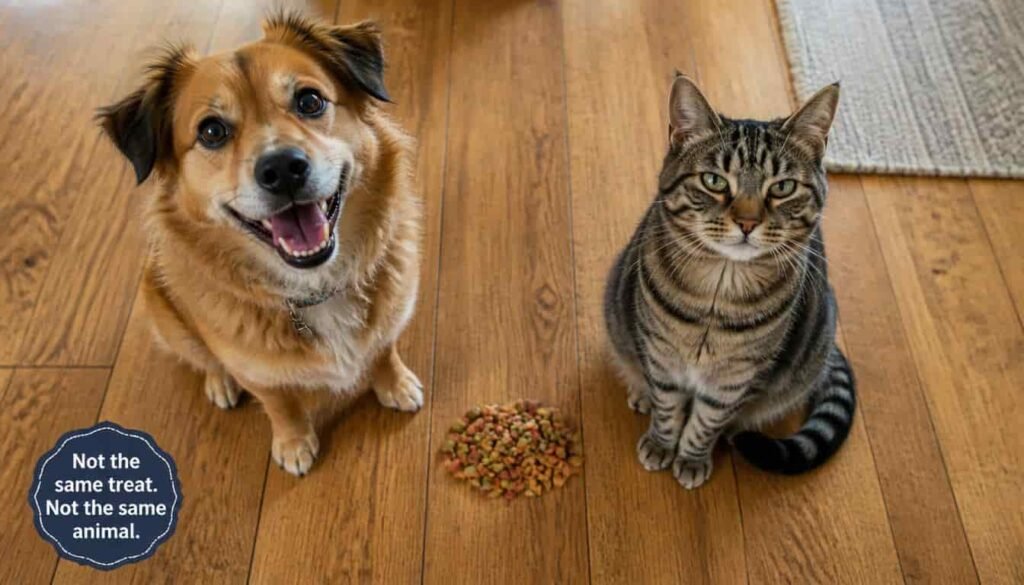
You turn around for one second — and there’s your dog, nose buried in the cat’s treat bag, tail going a hundred miles an hour, completely unashamed.
If you live with both a dog and a cat, this has probably happened to you. And the moment it does, the panic sets in: Is this okay? Should I be worried? Do I need to call the vet?
Here’s the quick answer: a cat treat or two won’t hurt most healthy dogs. But that’s not the whole story — and “not immediately dangerous” isn’t the same as “fine to keep doing.”
Cat treats are built for a completely different animal. The ingredients, the nutrient ratios, the calorie density — none of it is designed with your dog’s body in mind. One stolen treat? Relax. A daily habit, or an entire bag gone in one sitting? That’s when it matters.
In this guide, you’ll get the full picture:
- Why dogs are so obsessed with cat treats in the first place
- What’s actually different between cat and dog treats (and why it matters)
- A brand-by-brand breakdown of Temptations, Churu, and Delectables
- Ingredients on cat treat labels you should always check for
- Exactly what to do if your dog ate a whole bag
- Whether cats can eat dog treats (the reverse question — and it’s actually more serious)
- Practical tips for keeping the peace in a multi-pet household
Let’s get into it.
Why Do Dogs Love Cat Treats So Much?
Before we get into safety, it helps to understand why your dog wants them so badly in the first place.
Cats are obligate carnivores — their bodies run almost entirely on animal protein and fat. So cat treats are formulated to match that: dense, meaty, rich, and intensely aromatic. To your dog’s nose — which is somewhere between 10,000 and 100,000 times more sensitive than yours — a bag of cat treats basically smells like a steakhouse.
Dogs are also opportunistic eaters by nature. They’re hardwired to seek out the most calorie-dense, protein-rich food available. Cat treats hit that instinct perfectly.
The simplest way to think about it: cat treats are junk food for dogs. The same reason a kid will always grab the candy over the apple. It’s not a behavior problem — it’s just biology doing its thing.
The unfortunate side effect of all this? Your dog will almost always prefer cat treats over their own. Which makes keeping them separated less of a suggestion and more of a necessity.
alsoo read👉Odie Pet Insurance Review 2025: Is It Actually Worth Your Money?
Cat Treats vs. Dog Treats — What’s Actually Different?

The core reason cat treats aren’t great for dogs comes down to one simple fact: cats and dogs are not the same animal, and their food reflects that.
Dogs are omnivores — they do well on a mix of protein, carbohydrates, and fat. Cats are obligate carnivores — they’re biologically dependent on animal protein and fat to survive, and have almost no use for carbohydrates.
Cat treats are built around feline biology. Here’s what that means in practice:
Protein — Cat treats are very high in animal protein. Dogs need protein too, but not at the same concentration. Too much over time puts unnecessary strain on the kidneys and liver.
Fat — Higher fat content is normal in cat treats. For dogs, especially those prone to pancreatitis, this is the biggest concern.
Taurine — An essential amino acid that cats must get from food because they can’t produce it themselves. Dogs manufacture their own taurine, so the added taurine in cat treats isn’t harmful — but it signals the treat was designed for a fundamentally different metabolism.
Sodium — Cat treats tend to run higher in sodium than dog treats. Occasional exposure is fine; regular feeding adds up.
Calories — Cat treats are calorie-dense in a small package. Easy to underestimate how much your dog is actually consuming.
Here’s a simple comparison:
| Dog Treats | Cat Treats | |
|---|---|---|
| Protein level | Moderate | Very high |
| Fat level | Moderate | Higher |
| Carbohydrates | Higher | Very low |
| Sodium | Lower | Often higher |
| Calories per piece | Lower | Higher |
| Taurine added | No | Yes |
None of this makes cat treats poisonous to dogs. It just means they’re the wrong fuel for the wrong engine — and over time, that mismatch adds up.
Can Dogs Eat Cat Treats? The Full Answer
Alright — straight to it.
A few cat treats stolen off the floor? Almost certainly fine. For a healthy adult dog, the worst you’re likely to see is a slightly upset stomach or loose stools the next day. Not a crisis.
Regular cat treat snacking? This is where problems start. Over weeks and months, the high fat and calorie content can contribute to weight gain and put your dog at real risk of pancreatitis. The treats also don’t provide the nutritional balance dogs need — so they’re replacing good calories with the wrong ones.
An entire bag in one sitting? That’s a separate conversation — covered fully in its own section below.
The 90/10 Rule
Vets commonly recommend that at least 90% of your dog’s daily calories come from their complete, balanced dog food. Treats — of any kind — should cover no more than 10%.
The problem with cat treats is how quickly they eat into that 10%. A small handful of Temptations, for example, can be 50–80 calories — a significant chunk of a small dog’s entire treat budget for the day. Most people don’t realize how fast it adds up, especially in households where multiple family members are feeding the pets throughout the day.
The Bottom Line
| Scenario | Risk Level |
|---|---|
| 1–2 treats, healthy adult dog | Very low |
| Regular daily treats | Moderate — weight gain, pancreatitis risk |
| Large quantity at once | Higher — especially in small or at-risk dogs |
| Dog with pancreatitis, kidney disease, or obesity | Any amount warrants caution |
One treat isn’t a vet visit. A daily habit is worth stopping.
Brand Spotlight — Can Dogs Eat These Specific Cat Treats?

This is what most people are actually searching for. Not the general answer — the specific one. My dog just ate Temptations. My dog licked a Churu tube. Is that okay?
Here’s the breakdown by brand.
Can Dogs Eat Temptations Cat Treats?
Temptations are probably the most commonly stolen cat treat on the planet. They’re crunchy, they smell incredible to dogs, and they’re usually left out in an accessible spot.
Key ingredients: Chicken by-product meal, ground corn, animal fat, natural flavors, artificial colors (Red 40, Yellow 5, Yellow 6), added vitamins and minerals.
Are they toxic to dogs? No. Nothing in a Temptations treat will poison your dog.
What to be aware of:
- The artificial colors and by-product meal offer zero benefit to dogs
- Fat and sodium content is higher than ideal
- Dogs with a pancreatitis history are at real risk — even a small amount of high-fat food can trigger a flare
Verdict: Stole one or two? Don’t stress. Intentionally feeding them regularly? Not a good idea.
Can Dogs Eat Churu Cat Treats?
Churu has built a cult following — and dogs are every bit as obsessed as cats.
Key ingredients: Water, tuna or chicken, tapioca starch, natural flavors, guar gum, Vitamin E. No grains, no artificial colors, no preservatives.
Are they toxic to dogs? No — and Churu actually has one of the cleanest ingredient lists of any popular cat treat.
What makes Churu different:
- Only around 6 calories per tube — much lighter than dry treats
- 91% moisture — not a calorie bomb
- Simple, recognizable ingredients mean less risk of additives causing issues
Still worth noting:
- Tuna-based varieties are relatively high in sodium
- Still not nutritionally balanced for dogs
Verdict: If your dog licked a Churu tube, you have very little to worry about. Still a cat treat — but among the most harmless ones a dog could get into.
Can Dogs Eat Delectables Squeeze Up for Cats?
Similar format to Churu — lickable, high moisture, popular in multi-pet homes.
Key ingredients: Water, tuna, chicken broth, chicken, modified corn starch, natural flavors, salt.
Are they toxic to dogs? No.
Worth watching:
- The salt content is notable — particularly a concern for small breeds or dogs with cardiac or kidney issues
- Modified corn starch is a filler that does nothing for dogs
Verdict: Low risk from one accidental serving. Dogs with heart or kidney conditions should avoid due to the sodium. Not a treat to share intentionally.
Ingredients in Cat Treats You Should Watch Out For
Most cat treats won’t seriously harm your dog. But a few specific ingredients are worth knowing — because some are genuinely dangerous, and others show up more often than you’d expect.
Before you let your dog anywhere near a cat treat, a quick label scan can tell you everything you need to know.
Propylene Glycol Found in some soft or semi-moist cat treats as a moisture-retention agent. It’s FDA-approved for cats but has been removed from dog food formulations over safety concerns. Not acutely toxic in a single small exposure, but worth avoiding in any treat you’d give a dog regularly.
High Sodium A consistent issue across most cat treat brands. Fine occasionally, but regular feeding adds up — particularly for dogs with heart disease, kidney disease, or high blood pressure.
Artificial Colors (Red 40, Yellow 5, Yellow 6) No nutritional value for either species. Some dogs with sensitivities will react with skin irritation or digestive upset. More of a quality concern than a safety one — but a reason to favour cleaner-label treats regardless.
Onion or Garlic Powder Rare in mainstream cat treats, but not unheard of in “savory” flavored varieties. Both are toxic to dogs — and to cats, for that matter. This one is non-negotiable: if you see either on the label, keep the treat away from your dog entirely.
Xylitol Extremely toxic to dogs. Even a small amount can cause dangerous blood sugar crashes and liver damage. Xylitol is uncommon in pet treats — it turns up more in human foods and some dog dental products — but always worth a check.
How to Quickly Scan a Cat Treat Label
You don’t need to read every word. Just do this:
- Check the first five ingredients — these are present in the highest amounts
- Scan the full list for: garlic powder, onion powder, xylitol, propylene glycol
- Note the sodium level if your dog has any health conditions
Takes about 20 seconds. Worth doing once per product you keep in the house.
🚨 My Dog Ate a Whole Bag of Cat Treats — What Do I Do?

First — breathe. This is one of the most searched pet panics on the internet, and in most cases it turns out fine. Cat treats are not rat poison. But the quantity matters, and so does your dog’s size and health history.
Here’s exactly what to do, step by step.
Step 1: Figure Out What You’re Actually Dealing With
Before you spiral, gather the facts:
- What brand and type of treat did they eat?
- Roughly how many — or how much of the bag is gone?
- How big is your dog?
- Any known health conditions — especially pancreatitis, kidney disease, or obesity?
A 65-pound Labrador eating 30 Temptations is a very different situation from a 9-pound Chihuahua eating the same amount. Context is everything here.
Step 2: Watch for These Symptoms Over the Next 12–24 Hours
Most symptoms — if they appear at all — will show up within this window:
- Vomiting or diarrhea
- Lethargy or unusual tiredness
- Bloated or hard abdomen
- Excessive thirst or urination
- Loss of appetite
- Hunching, restlessness, or signs of belly pain
Mild vomiting or loose stools once or twice? Likely just the digestive system doing its job. Repeated vomiting, bloating, or lethargy? Call your vet.
Step 3: Know When to Call the Vet Immediately
Don’t wait and see if any of these apply:
- Your dog is a small breed and ate a large quantity
- They have a history of pancreatitis
- You’re seeing vomiting, bloating, or lethargy within a few hours
- The treats contained garlic powder, onion powder, or xylitol
- They also ate the packaging — plastic and foil wrappers are an obstruction risk
What to tell your vet: the brand, approximate quantity, your dog’s weight and age, any health conditions, and how long ago it happened. The more specific you are, the faster they can help.
Dogs Most at Risk
These dogs need a vet call sooner rather than later, even if symptoms seem mild:
- Small and toy breeds
- Senior dogs
- Dogs with pancreatitis history
- Dogs with kidney or heart disease
- Overweight dogs
The honest truth: most dogs who raid the cat treat bag come out the other side just fine — maybe a little gassy and very smug about it. But if your gut says something’s off, trust it and call your vet.
Which Dogs Should Never Eat Cat Treats?
For most healthy adult dogs, the occasional cat treat is a minor issue. But for some dogs, even a small amount is worth taking seriously. If your dog falls into any of the categories below, cat treats should be kept strictly out of reach — not just discouraged.
Dogs with pancreatitis This is the big one. The high fat content in cat treats is one of the most reliable pancreatitis triggers there is. A dog with a pancreatitis history doesn’t need a large quantity to have a problem — even a few rich treats can provoke a painful and potentially serious flare.
Overweight or obese dogs Cat treats are calorie-dense in a deceptively small package. If your dog is already on a weight management plan, a handful of cat treats can quietly undo days of careful feeding. It adds up faster than most people realize.
Dogs with kidney disease High protein and elevated sodium are both hard on kidneys that are already struggling. For dogs managing chronic kidney disease, diet control is one of the most important tools — and cat treats work directly against that.
Dogs with food allergies Fish, chicken, artificial colors, and various by-products are common ingredients in cat treats — and common canine allergens. If your dog has known sensitivities, the ingredient list on most cat treats is a minefield.
Senior dogs Older dogs have less metabolic flexibility. Their digestive systems, kidneys, and livers are less equipped to handle rich, species-inappropriate food. What a young healthy dog shrugs off, a senior dog may genuinely struggle with.
Small and toy breeds Their daily calorie budgets are so small that even one or two cat treats can represent a disproportionate hit. A single Temptations treat might be 5–8 calories — not much for a Labrador, but meaningful for a 6-pound Yorkie.
If your dog is in any of these groups and they’ve gotten into cat treats, it’s worth a call to your vet — even if they seem fine.
Can Cats Eat Dog Treats? (The Reverse Question)
Most people assume the reverse situation is roughly the same risk. It’s actually more serious — and worth knowing if you have both animals in the house.
The taurine problem Taurine is an essential amino acid that cats must get from their diet — their bodies can’t produce it. Dog treats are not formulated with added taurine. A cat that regularly snacks on dog treats instead of cat-appropriate food can develop a taurine deficiency over time, which leads to dilated cardiomyopathy (a serious heart condition) and vision deterioration. It won’t happen from one stolen treat — but it’s a real risk in households where boundaries are loose.
Wrong macronutrient balance Dog treats are designed for omnivores — they tend to be higher in grains and carbohydrates than anything a cat should regularly eat. Cats have a very limited ability to process carbohydrates efficiently. Regular excess carb intake contributes to obesity and blood sugar problems in cats.
Size and choking Many dog treats — biscuits, chews, jerky strips — are physically too large for a cat to safely handle. Choking and dental damage are both real risks.
Xylitol in dog dental chews This one is critical. Some dog dental treats and chews contain xylitol — which is just as toxic to cats as it is to dogs. A cat getting into dog dental chews is a genuine emergency. Check your dog’s dental treat ingredients and store them completely out of your cat’s reach.
The bottom line: A cat stealing one small dog biscuit is probably fine. But the risks on this side of the equation — particularly taurine deficiency and xylitol exposure — are more significant than most people realize. Dog treats belong to dogs. Keep them that way.
Can Dogs Eat Catnip?
Short answer: yes, catnip is non-toxic to dogs. If your dog ate some loose catnip or demolished a catnip toy, there’s nothing to worry about.
The reason cats go wild for catnip is a compound called nepetalactone, which binds to feline olfactory receptors and triggers that familiar euphoric, rolling-around response. Dogs simply don’t have the same receptor chemistry — so the “catnip effect” doesn’t happen for them. No zoomies, no rolling, no bliss.
What dogs might experience in large amounts:
- Mild sedation
- Slight digestive upset — loose stools or vomiting if they ate a significant quantity
Neither is dangerous, and both resolve quickly on their own.
One thing worth noting: some cat treats are catnip-flavored or contain catnip as an ingredient. If your dog gets into those, the catnip itself isn’t your concern — the rest of the treat formula is. Apply the same logic as any other cat treat: a small amount is likely fine, check the label for any red-flag ingredients, and don’t make it a habit.
Practical Tips for Multi-Pet Households

Knowing the risks is one thing. Actually keeping your dog out of the cat’s treats when you share a home with both animals — that’s the real challenge. Here are the strategies that actually work.
Store cat treats properly Not on the counter. Not on a low shelf. Dogs are resourceful, and a treat bag left within reach is basically an open invitation. Keep cat treats in a sealed container inside a closed cabinet. If your dog is a serious counter-surfer, go higher.
Feed pets separately Feed your cat in a separate room, on an elevated surface, or behind a baby gate your dog can’t pass. This removes the opportunity entirely — no hovering, no stealing, no stress for either animal.
Train “leave it” A solid “leave it” command is one of the most practical investments you can make in a multi-pet household. When your dog goes for the cat’s bowl or a dropped treat, one word stops it. If your dog doesn’t have this command yet, it’s worth the time to teach it.
Upgrade your dog’s treats Sometimes the obsession with cat treats is simply because the dog’s own treats aren’t very exciting. A higher-quality, more aromatic dog treat can take the edge off. Give your dog something worth being enthusiastic about.
Apply the 90/10 rule consistently Track treat calories across the whole day — from everyone in the household. It’s easy for treats to quietly stack up when multiple people are feeding the pets. Cat treats, dog treats, table scraps — it all counts toward that 10%.
Consider a cat-only feeding station Wall-mounted feeders or enclosed feeding boxes designed to keep dogs out are a practical solution for persistent treat thieves. Cats can access them easily; dogs physically can’t. Worth the investment if you’ve tried everything else.
Small adjustments to the household routine make a bigger difference than you’d think. Most multi-pet treat problems come down to access and habit — fix those, and the problem usually solves itself.
Frequently Asked
Is it okay to give a dog cat treats?
Occasionally and in very small amounts — yes, for a healthy adult dog. Cat treats aren’t toxic, but they’re not nutritionally appropriate for dogs either. One or two stolen treats is nothing to worry about. Intentionally giving them as a regular snack is a different story.
What happens if a dog eats a cat treat?
For most healthy dogs, not much. Maybe some mild stomach upset or loose stools — that’s the worst of it in most cases. If your dog ate a large quantity, or has a health condition like pancreatitis, the risk goes up. Watch for vomiting, lethargy, or bloating and call your vet if anything seems off.
What is the 90/10 rule for dogs?
It’s a simple veterinary guideline: at least 90% of your dog’s daily calories should come from their complete, balanced dog food. Treats of any kind — including cat treats — should make up no more than 10%. Cat treats are calorie-dense, so that 10% disappears faster than most people expect.
Why do dogs love cat treats so much?
Because cat treats are essentially junk food from a dog’s perspective. They’re higher in animal fat and protein than dog treats, which makes them smell and taste far more intense and rewarding. Dogs are hardwired to seek out calorie-rich food — cat treats check every box.
Can you give dog treats to cats?
It’s not a good idea — and honestly riskier than the reverse. Dog treats don’t contain taurine, which cats must get from their diet. Regular consumption can lead to taurine deficiency over time, causing serious heart and vision problems. Some dog dental chews also contain xylitol, which is toxic to cats. Keep them separate.
Can dogs eat catnip?
Yes — catnip is completely non-toxic to dogs. Unlike cats, dogs don’t get any behavioral effect from it. Large amounts might cause mild stomach upset, but nothing dangerous. If your dog ate a catnip toy or some loose catnip, you can relax.
Why can’t dogs have cat food regularly?
Cat food — including treats — is formulated for an obligate carnivore’s needs: very high protein, high fat, low carbohydrates. Fed regularly to a dog, this nutritional profile contributes to obesity, pancreatitis, and over time, strain on the kidneys and liver. It’s not about one meal or one treat — it’s about what happens when it becomes a pattern.
Conclusion
So — can dogs eat cat treats?
Yes, occasionally, in small amounts, without much to worry about for most healthy adult dogs. But “not immediately harmful” is a low bar. Cat treats are the wrong fuel for a dog’s biology, and the problems they cause tend to build quietly over time rather than announce themselves all at once.
The brands most people ask about — Temptations, Churu, Delectables — are all non-toxic in the amounts a dog is likely to steal. Churu is the most forgiving of the three. Temptations carry the most concern due to artificial additives and higher fat. None of them belong in your dog’s regular treat rotation.
If your dog just raided the cat treat bag, take a breath, check the label for anything genuinely dangerous, watch them for 24 hours, and call your vet if something feels wrong.
And going forward — sealed containers, separate feeding spaces, a solid “leave it” command. That’s really all it takes.
Your dog deserves treats made for your dog. Everything else is just borrowing trouble.
Have a dog and a cat at home? Share this with someone who needs it — and if your vet has ever given you advice on this topic, their guidance always takes priority over anything you read online.